彩色碳:創(chuàng)有色納米管薄膜
日期:2018-09-10
來(lái)源:
瀏覽:689
研究人員提出了一種技術(shù),可以在彩虹的選擇陰影下生產(chǎn)大量原始的單壁碳納米管。秘訣是經(jīng)過(guò)微調(diào)的制造工藝和少量的二氧化碳。
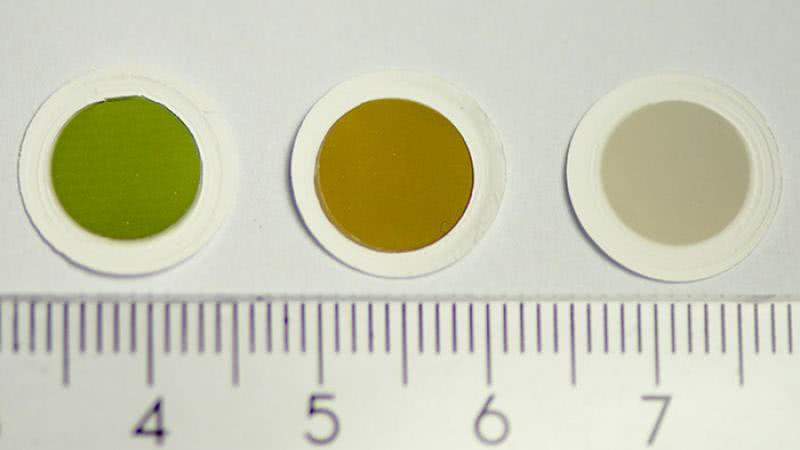
彩色碳納米管薄膜的樣品,如在制造反應(yīng)器中產(chǎn)生的。圖片:阿爾托大學(xué)。
單壁碳納米管或一個(gè)原子厚度的石墨烯層卷成不同的尺寸和形狀,已經(jīng)在電子和新的觸摸屏設(shè)備中找到了許多用途。本質(zhì)上,碳納米管通常是黑色或深灰色。
在他們發(fā)表在美國(guó)化學(xué)學(xué)會(huì)期刊(JACS)上的新研究中,阿爾托大學(xué)的研究人員提出了一種控制碳納米管薄膜制造的方法,以便它們顯示出各種不同的顏色 - 例如綠色,棕色或銀灰色。
研究人員認(rèn)為,這是次通過(guò)直接合成生產(chǎn)有色碳納米管。使用他們的發(fā)明,在制造過(guò)程中直接引起顏色,而不是在成品合成管上采用一系列凈化技術(shù)。
通過(guò)直接合成,可以生產(chǎn)大量清潔的樣品材料,同時(shí)避免在凈化過(guò)程中損壞產(chǎn)品 - 這使其成為具吸引力的應(yīng)用方法。
“從理論上講,這些彩色薄膜可以用來(lái)制作具有多種不同顏色的觸摸屏,或者太陽(yáng)能電池可以顯示出全新的光學(xué)特性,”阿爾托大學(xué)教授Esko Kauppinen說(shuō)。
讓碳結(jié)構(gòu)顯示顏色本身就是一項(xiàng)壯舉。實(shí)現(xiàn)著色所需的基礎(chǔ)技術(shù)也意味著對(duì)納米管結(jié)構(gòu)的結(jié)構(gòu)的精細(xì)控制。Kauppinen和他的團(tuán)隊(duì)獨(dú)特的方法,使用金屬和碳的氣溶膠,使他們可以直接從制造過(guò)程中仔細(xì)操縱和控制納米管結(jié)構(gòu)。
“在某種程度上,生長(zhǎng)碳納米管就像植樹(shù)一樣:我們需要種子,飼料和太陽(yáng)熱。對(duì)我們來(lái)說(shuō),鐵的氣溶膠納米粒子可以作為催化劑或種子,一氧化碳作為碳的來(lái)源,所以飼料和“反應(yīng)堆在850攝氏度以上的溫度下發(fā)熱,”阿爾托大學(xué)資深科學(xué)家華江博士說(shuō)。
Kauppinen教授的團(tuán)隊(duì)在他們的單一生產(chǎn)方法中使用這些資源的歷史悠久。為了增加他們的曲目,他們近嘗試在制造過(guò)程中施用小劑量的二氧化碳。
“二氧化碳是一種可用于調(diào)節(jié)各種顏色碳納米管生長(zhǎng)的移植材料,”江解釋說(shuō)。
利用先進(jìn)的電子衍射技術(shù),研究人員能夠找到其薄膜的精確原子尺度結(jié)構(gòu)。他們發(fā)現(xiàn)它們具有非常窄的手性分布,這意味著管壁的蜂窩晶格的取向在整個(gè)樣品中幾乎是均勻的。手性或多或少地決定了碳納米管可具有的電特性以及它們的顏色。
在阿爾托大學(xué)開(kāi)發(fā)的方法承諾以高產(chǎn)率制造碳納米管薄膜的簡(jiǎn)單且高度可擴(kuò)展的方法。
“通常你必須在批量生產(chǎn)或?qū)μ技{米管結(jié)構(gòu)有良好控制之間做出選擇。憑借我們的突破,我們可以做到這兩點(diǎn),”該集團(tuán)博士后研究員張強(qiáng)博士表示。
后續(xù)工作已在進(jìn)行中。
“我們希望了解二氧化碳添加如何調(diào)整納米管結(jié)構(gòu)并產(chǎn)生顏色的科學(xué)。我們的目標(biāo)是實(shí)現(xiàn)對(duì)生長(zhǎng)過(guò)程的完全控制,以便單壁碳納米管可用作構(gòu)建塊的基礎(chǔ)。下一代納米電子器件,“Kauppinen教授說(shuō)。
原文如下:
Researchers present a technique to produce large quantities of pristine single-walled carbon nanotubes in selec shades of the rainbow. The secret is a fine-tuned fabrication process—and a small dose of CO2.
Samples of the colourful carbon nanotube thin films, as produced in the fabrication reactor. Image: Aalto University.
Samples of the colourful carbon nanotube thin films, as produced in the fabrication reactor. Image: Aalto University.
Single-walled carbon nanotubes, or sheets of one atom-thick layers of graphene rolled up into different sizes and shapes, have found many uses in electronics and new touch screen devices. By nature, carbon nanotubes are typically black or a dark grey.
In their new study published in the Journal of the American Chemical Society (JACS), Aalto University researchers present a way to control the fabrication of carbon nanotube thin films so that they display a variety of different colours—for instance, green, brown, or a silvery grey.
The researchers believe this is the first time that coloured carbon nanotubes have been produced by direct synthesis. Using their invention, the colour is induced straight away in the fabrication process, not by employing a range of purifying techniques on finished, synthesized tubes.
With direct synthesis, large quantities of clean sample materials can be produced while also avoiding damage to the product in the purifying process—which makes it the most attractive approach for applications.
"In theory, these coloured thin films could be used to make touch screens with many different colours, or solar cells that display completely new types of optical properties," says Esko Kauppinen, Professor at Aalto University.
To get carbon structures to display colours is a feat in itself. The underlying techniques needed to enable the colouration also imply finely detailed control of the structure of the nanotube structures. Kauppinen and his team’s unique method, which uses aerosols of metal and carbon, allows them to carefully manipulate and control the nanotube structure directly from the fabrication process.
"Growing carbon nanotubes is, in a way, like planting trees: we need seeds, feeds, and solar heat. For us, aerosol nanoparticles of iron work as a catalyst or seed, carbon monoxide as the source for carbon, so feed, and a reactor gives heat at a temperature more than 850 degrees Celsius," says Dr. Hua Jiang, Senior Scientist at Aalto University.
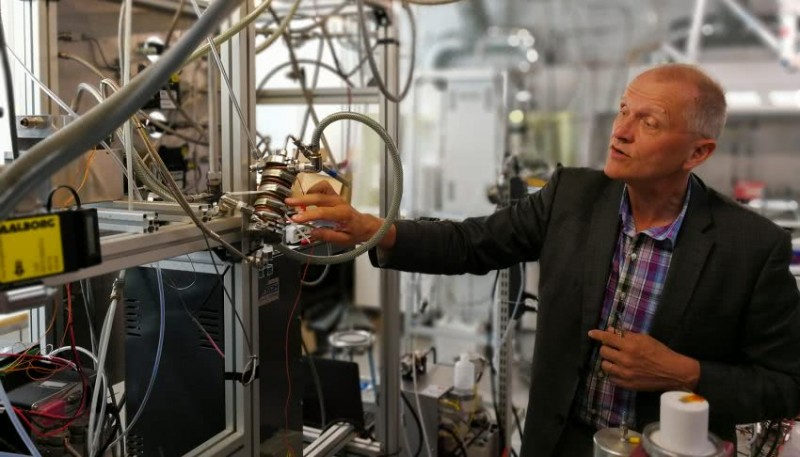
Professor Esko Kauppinen with the fabrication reactor.
Professor Kauppinen’s group has a long history of using these very resources in their singular production method. To add to their repertoire, they have recently experimented with administering small doses of carbon dioxide into the fabrication process.
"Carbon dioxide acts as a kind of graft material that we can use to tune the growth of carbon nanotubes of various colors," explains Jiang.
With an advanced electron diffraction technique, the researchers were able to find out the precise atomic scale structure of their thin films. They found that they have very narrow chirality distributions, meaning that the orientation of the honeycomb-lattice of the tubes’ walls is almost uniform throughout the sample. The chirality more or less dictates the electrical properties carbon nanotubes can have, as well as their colour.
The method developed at Aalto University promises a simple and highly scalable way to fabricate carbon nanotube thin films in high yields.
"Usually you have to choose between mass production or having good control over the structure of carbon nanotubes. With our breakthrough, we can do both," trusts Dr. Qiang Zhang, a postdoctoral researcher in the group.
Follow-up work is already underway.
"We want to understand the science of how the addition of carbon dioxide tunes the structure of the nanotubes and creates colours. Our aim is to achieve full control of the growing process so that single-walled carbon nanotubes could be used as building blocks for the next generation of nanoelectronics devices," says professor Kauppinen.

 English
 簡(jiǎn)體中文